













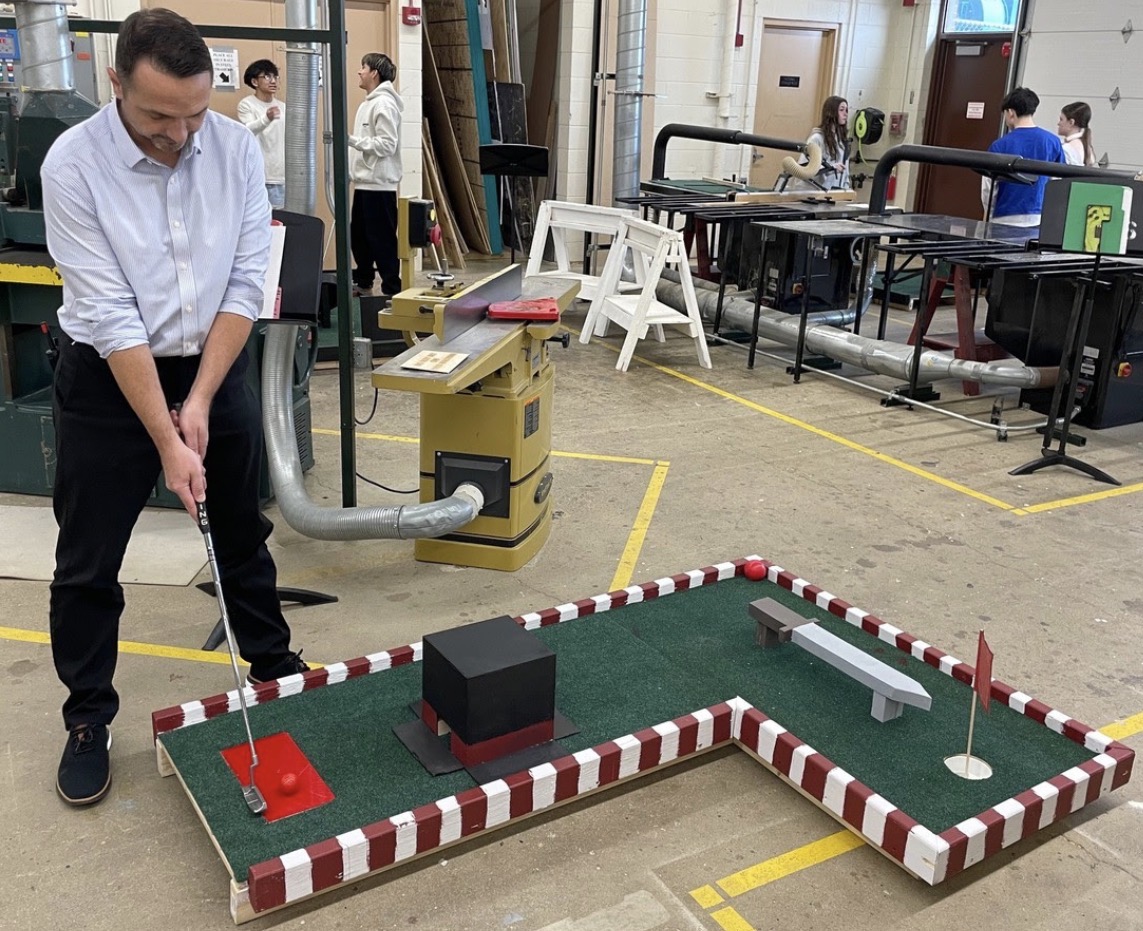
This semester, Geometry in Construction students took their learning to the next level by designing and building their very own miniature golf course. What started as brainstorming sessions and rough sketches quickly transformed into a fully constructed, playable course that combined imagination, precision, and craftsmanship.
Each group began by developing a unique theme and designing a hole that would both challenge and entertain players. Themes ranged from Beach Theme and NASCAR to SpongeBob – Bikini Bottom and Outer Space.
Other creative concepts included Aqua Splash, Aquarium, The Circus, Stranger Things, Pirates Life, Pinball Classic, Mexico, Tokyo, The Soccer Field, World Cup, Da Bears, GTA 6 – Miami, and, of course, Geometry in Construction.
Most of the project’s mathematical challenges emerged during the design phase rather than during construction. Students first developed their themes and worked out solutions on graph paper, carefully planning measurements, angles, and obstacle placement before building began.
They then created scaled-down prototypes to test layouts and ensure their holes would function as intended. The main challenge was fitting obstacles within the board’s dimensions while maintaining a playable and engaging course.
“Many challenges come from building ramps that are not too big for the board and aren’t too tall for the ball to actually travel up. The solution is usually to shrink the length and angle of the ramp so students can build it on their own,” said Mr. Strauch, the sponsor and a math teacher.
Behind every obstacle and curve was math. Students calculated angles of incidence and reflection to determine how a golf ball would bounce off a wall. They applied geometric principles to measure slopes, design ramps, and ensure their holes were fair and functional.
After solving the math behind their designs, students brought their plans to life in the woodshop. Using power tools, CNC machines, and hands-on construction techniques, they carefully built each obstacle and structure. Students completed most of the construction independently, cutting and building the border walls, the base, and most obstacles, while teachers assisted with a few tasks like tunnel cutting and ramp assembly.
Safety, measurement accuracy, and teamwork were essential throughout the process. Once construction was complete, students added finishing touches with paint and detailed decorations to fully immerse players in each theme.
“Every year, some students dream a little too big and create obstacles that cannot be completed in the 3–4 weeks we have in class. We try our best to help create something that matches their theme but isn’t too big or complicated,” said Mr. Strauch.
The final result was an interactive mini golf course that showcased creativity, collaboration, problem-solving, and technical skill. Students experienced firsthand how geometry applies to real-world design and engineering, learning that math is the foundation behind structures and motion.
This was the fourth year the Geometry in Construction class completed the mini-golf project, and the program plans to continue building it in future semesters. Small adjustments are made each year; this year, the base of each hole was raised higher than in past years.
Students complete a feedback form, which asks what they learned, what they would change, and their favorite hole. As they play the holes, students also reflect on the differences between their hole and the others, and their ideas are incorporated into improvements for the next school year.